
Trump Bringing Peace to the Middle East?
It appears so and here's how and why:
StatehoodForPeace.Com
10/21/202515 min read
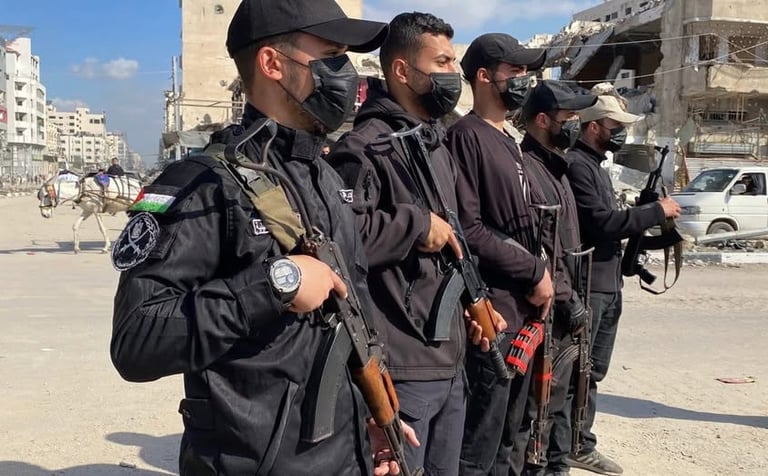
Hamas is hunting down groups in Gaza that collaborated with the Israeli army, one by one.
Ever since the ceasefire with Israel came into effect, Hamas has launched a wide-ranging security campaign to crack down on armed gangs that were responsible for looting humanitarian aid during the war.
In some cases, those gangs were tasked by the Israeli army with fighting Hamas directly, while reportedly receiving arms, training, funding, and logistical field support from Israel. Netanyahu also publicly admitted to the policy in June.
The state of chaos was made possible due to the power vacuum created by Israel’s declared policy of systematically targeting Hamas civil servants, including the local police force responsible for maintaining public order and fighting crime.
This forced the Gaza police to go into hiding following the breakdown of the previous ceasefire in March, allowing for clans and other armed groups to loot aid under Israeli protection
Palestinians say this was part of an intentional Israeli policy of appearing to let aid into Gaza but making sure it doesn’t get to those who need it
The Hamas-run police maintained a high degree of public security after the militants seized power in Gaza 18 years ago while also cracking down on dissent. They largely melted away in recent months as Israeli forces seized large areas of Gaza and targeted Hamas security forces with airstrikes.
Powerful local families and armed gangs — including some anti-Hamas factions backed by Israel — stepped into the void. Many are accused of hijacking humanitarian aid and selling it for profit, contributing to Gaza’s starvation crisis.
Nahed Sheheiber, head of Gaza’s private truckers union, said Hamas was acting against gangs that had terrorized people in areas controlled by Israel.
“Those gangs looted aid and killed people under the protection of the (Israeli) occupation,” he told AP, saying they operated in so-called red zones where Israel had ordered people to evacuate
“Anyone who expects Israel to help those same clans is mistaken. It looks like Israel has left them to deal with this alone,” one Israeli officer tells Haaretz.com.
Trump said he wasn’t bothered by the Hamas crackdown, admitting that it “did take out a couple of gangs that were very bad.”
“We have been dealing with criminals and outlaws using 2 frameworks,” a security source in Gaza’s Ministry of Interior told Mondoweiss:
“The st framework allows us to grant them amnesty or try them before a court if they surrender themselves and cooperate with the security forces.
But in the nd framework, we pursue every single outlaw with all our power, wherever they are. Our operations will root them all out, without exception.”
“These families have taken advantage of the proximity of their areas to the Israeli army’s military operations to act against Gaza and its people,” the source explained. “They have waylaid convoys, looted aid, and abducted and terrorized citizens."
"Any act we are doing aims to impose order and the law, and we have the full support of the clans. We are also working to prevent attempts to create chaos, which is being fomented by outsiders and groups connected to the Palestinian Authority.”
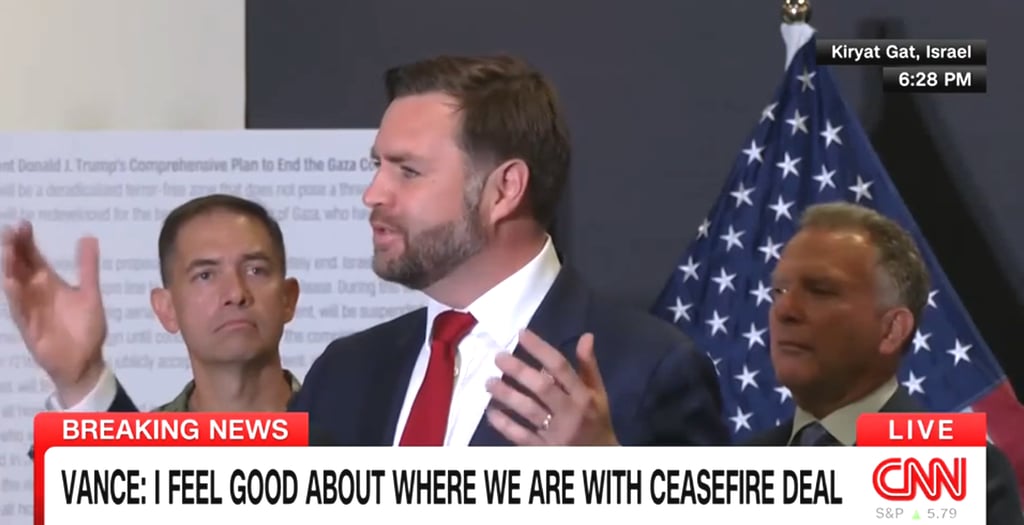

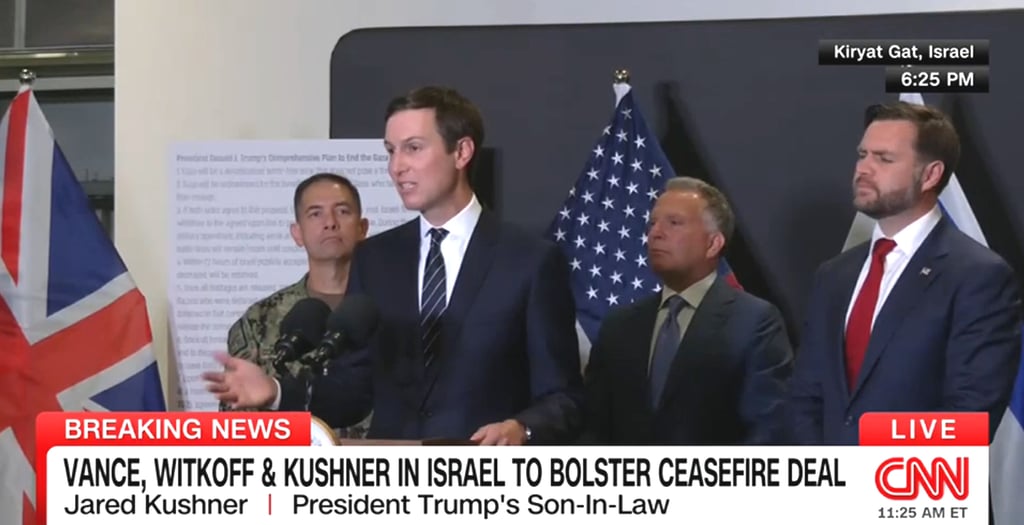
CNN Transcript 10/21/2025 Vance, Witkoff, Kushner Press Conference - Kinyat Gat, Israel
J.D. VANCE, VICE PRESIDENT OF THE UNITED STATES: The Israeli government has been remarkably helpful in this. I want to thank them, thank our Israeli partners, and all the folks, particularly who are working hand-in-hand with their American friends here at the CMCC.
And, number two, I want to say that there is this weird attitude I have sensed in the American media and the Western media where there's almost this desire to root for failure, that every time something bad happens, that every time that there's an act of violence, there's this inclination to say, oh, this is the end of the cease-fire, this is the end of the peace plan.
It's not the end. It is, in fact, exactly how this is going to have to happen when you have people who hate each other who have been fighting against each other for a very long time. We are doing very well. We are in a very good place. We're going to have to keep working on it. But I think we have the team to do exactly that.
So, with all thanks to our partners, both in Israel, but all across the Gulf Arab states, Indonesia, the Turks, we are doing an amazing thing here. And I'm particularly proud of the American troops working at the command center who are coordinating this effort and making it possible.
So, with that, I want to thank Ambassador Steve Witkoff and turn it over to him to say a few things. And after everybody's said a few words, we will take some questions. Thank you, guys.
Steve.
STEVE WITKOFF, U.S. SPECIAL ENVOY TO THE MIDDLE EAST: Well, thank you very much, Mr. Vice President. We're really proud of what's happened here. It's an amazing effort.
It's a great coordination between our partners. We have a great team. Signing this deal up was a challenge, in and of itself. But the implementation, that's where it really is going to be the most important.
And I think we are exceeding where we thought we would be at this time. I think the vice president has come out here. He sees that. The secretary of state will be out here. I can't tell you what a privilege it is to work with the team that we have with Jared, who's extraordinary, the president, of course, the vice president, and Admiral Cooper.
I would also say this. We're learning so much here. This CCCM that we are -- CMCC that we're setting up now, this is going to be used in other conflicts as we figure out all the intricacies of how to modulate a peace deal, go from war to peace.
[11:15:10]
Lastly, in closing, I want to speak about the morning that me and Jared had. We met with 10 hostages and their families. And it was really an emotional moment. And I felt blessed to be in that room, lots of tears, lots of people, really, really grateful to President Trump for getting their children home and you, of course, Mr. Vice President.
And I want to observe that I didn't see any victims in that room. I saw strong people who have come out under very difficult circumstances. Their families are reunited, and they are so grateful. And it was just my privilege as an American to be there. Thank you.
VANCE: Great. Thank you.
Jared.
JARED KUSHNER, FORMER SENIOR PRESIDENTIAL ADVISER: Thank you. Thank you, Mr. Vice President. Thank you, Steve.
First of all, we really appreciate your visit here. It's given a great boost of energy to everyone here and your support through this whole effort has been really tremendous. What you see here today is really the opening of the CMCC.
This has been something that's been envisioned by CENTCOM. Admiral Cooper will speak about that in a bit. But we always knew that the deal that we were working on would kind of have two phases to it. The first phase was obviously getting the live hostages out. We're currently making progress on the hostages, the bodies that are still there.
I think almost half are out now, and we had very good meetings with the Israelis. I know the vice president is here to put a lot of effort into that today to hopefully make sure we can complete that mission in phase two. At the same time, the humanitarian aid, there's actually been
surprisingly strong coordination between the United Nations and Israel, which is something that we have been able to help synthesize, get each other to air their concerns and to find out how we can do it better so that the aid reaches the people in Gaza and doesn't go into the wrong hands there.
Finally, I will say that there has already been a lot of efforts over the last years by really concerned people to think about what happens next in Gaza. And there are a lot of great things happening here. More will be released in the coming days. But the most important thing here is to figure out how you really get a good deconfliction coordination center.
This really has been a start-up. There's been a lot that's been done. It's amazing to think it's only been a week. Actually, with the pace of work and the commitment of everybody, I think in a week from now, you will see even more progress.
I want to echo what the vice president said about how a lot of people are getting a little hysterical about different incursions one way or the other, but what we are seeing is that things are going in accordance. Both sides are transitioning from two years of very intense warfare to now a peacetime posture and really thanks to Admiral Cooper, CENTCOM and the CMCC to try to build that deconfliction mechanism in order to make sure that we can get to a proper de-escalation.
We have some flags that we have put up here. This is not fully representative of the countries that are here. It's happening very rapidly that people are agreeing to come on board, agreeing to help. People really want to be a part of this, and it's just happening very, very quickly.
So we will try to continue to give the updates as it progresses, but really just thank you to the entire team here who's made all this possible. It's been a lot of sleepless nights, around-the-clock effort, and it's really been great coordination, because everyone believes that it is possible to create something better in Gaza and we have to believe it.
We have to work hard for it. And if we all work hard to do that, then I do believe a great outcome is possible.
VANCE: Thanks, Jared.
Admiral.
ADM. BRAD COOPER, CENTRAL COMMAND COMMANDER: Well, Mr. Vice President, thank you for joining us here today at the CMCC.
Consistent with our commander in chief's direction, this facility will be the hub for the delivery of everything that goes into Gaza as we look to the future, delivering on the commander in chief's commitments; 200 of America's sons and daughters who wear the cloth of the nation have stepped up and are serving here. I just couldn't be prouder, and I know that you are as well. Thank you
so much.
VANCE: Great. Thanks, Admiral.
And, gentlemen, we will take a few questions now.
Sir.
QUESTION: (OFF-MIKE)
VANCE: Well, I think, first of all, what troops are on the ground in Israel is going to be a question that the Israelis have to agree to. And I'm sure that Prime Minister Netanyahu will have opinions about that. But we think everybody has a role to play here.
Some of that's going to be financial. Some of that's going to be in reconstruction. Some of that's just in communication with the various parties to ensure that this deconfliction process actually works and is implemented.
[11:20:05]
We're not going to force anything on our Israeli friends when it comes to foreign troops on their soil, but we do think that there's a constructive role for the Turks to play. And, frankly, they have already played a very constructive role. We're very grateful for that.
And you asked, yes, they have supported Hamas in the past. No one who is a party to this conflict can look in the past and not point at something that they don't like or that they disagree with. Everybody who's been involved in this conflict can point at one other person. One of these flags can point at another flag and say, we hate that person for various reasons.
The way that we're going to get to peace is to focus on the future, which is what the president of the United States has asked us to do. And we think everybody here is very willing to do that and is very eager to engage in that effort.
Ma'am.
QUESTION: (OFF-MIKE)
VANCE: Well, Jared's the investor here. I'm not going to give you a percentage, but, look, what we have seen the past week gives me great optimism the cease-fire is going to hold.
And if we get from where we were a week ago to a long-term, durable peace between Israel and Gaza, there are going to be hills and valleys. There are going to be moments where it looks like things aren't going particularly well. But given that and given the history of conflict, I think that everybody should be proud of where we are today.
It's going to require constant effort. It's going to require constant monitoring and supervision. That's part of the reason that Admiral Cooper and his team is here is to mediate these disputes, to mediate these disagreements as they come up.
But, look, right now, I feel very optimistic. Can I say with 100 percent certainty that it's going to work? No. But you don't do difficult things by only doing what's 100 percent certain. You do difficult things by trying. And that's what the president of the United States has asked us to do.
Sir.
QUESTION: (OFF-MIKE)
VANCE: Yes, so, Steve, I'm going to ask you to follow up here.
But let me say just a couple of words about the deceased hostages. I mean, one of the stations that I met with, one of the groups that's working on this that I met with earlier, they actually have a photo of the 15 deceased hostages who are still in Gaza. It is a focus of everybody here to get those bodies back home to their families so that they can have a proper burial.
Now, that said, this is difficult. This is not going to happen overnight. Some of these hostages are buried under thousands of pounds of rubble. Some of the hostages, nobody even knows where they are. That doesn't mean we shouldn't work to get them, and that doesn't mean we don't have confidence that we will.
It's just a reason to counsel in favor of a little bit of patience. This is going to take a little bit of time. And, look, our warning to Hamas is very straightforward. The terms of the 20-point plan that the president put out there is very clear. It's supported not just by Israel, but by all of our Gulf Arab friends.
It's that Hamas has to disarm. It's that Hamas has to actually behave itself, and that Hamas, while all the fighters can be given some sort of clemency, they're not going to be able to kill each other, and they're not going to be able to kill their fellow Palestinians.
Now, again, that's going to take a little bit of time. We're talking about how to set up the security and humanitarian apparatus to put all this in place. But right now, where I stand, I feel confident that we're going to be in a place where this peace lasts, where it's durable.
And if Hamas doesn't cooperate, then, as the president of the United States has said, Hamas is going to be obliterated.
Steve, do you want to add anything about the hostages?
WITKOFF: I think you have said it, sir.
VANCE: OK, great.
Ma'am.
QUESTION: (OFF-MIKE)
VANCE: Well, look, the president actually put out a TRUTH this morning that I thought was very instructive. We know that Hamas has to comply with the deal, and if Hamas doesn't comply with the deal, very bad things are going to happen.
But I'm not going to do what the president of the United States has thus far refused to do, which is put an explicit deadline on it, because a lot of this stuff is difficult. A lot of this stuff is unpredictable. You basically have two regions in Gaza, one of which is relatively safe, I wouldn't say very safe, and one of which is incredibly dangerous.
And part of ensuring that we get to a durable peace is to broaden the scope of the area that's safe. And the international security force is a big part of that. We don't yet have the international security force set up. That's something we're working towards. We have a number of volunteers who want to participate in that international security force.
So my point is, I don't think it's actually advisable for us to say this has to be done in a week, because a lot of this work is very hard. It's never been done before. And in order for us to give it a chance to succeed, we have got to be a little bit flexible.
[11:25:06]
I think what you're seeing from our Gulf Arab friends, certainly from our Israeli friends, is a certain amount of impatience with Hamas, but we're going to keep on working at this process and we're going to keep on trying to bring the deceased hostages home, but also make sure that all Gazans are able to live in a prosperous and safe place.
Yes.
QUESTION: (OFF-MIKE)
VANCE: Yes, Jared, do you want to say a few words about that? Great.
KUSHNER: So, first of all, no reconstruction aid, no reconstruction funds will be going into areas that Hamas still controls. And as far as the demilitarization goes, once the ISF is up, there needs to be a security force that they can feel safe from that -- in order for it to be -- the transition to be complete.
So that needs to happen. There are considerations being -- happening now in the area that the IDF controls as long as that can be secured to start the construction as a new Gaza, in order to give the Palestinians living in Gaza a place to go, a place to get jobs, a place to live. So that's one of the many things being considered.
Right now, again, there's been several work streams that have occurred over the last years. Those are all being synthesized and updated here at the center. And then they will go before President Trump and the Board of Peace to get recommendations on what to build, how to phase it. But that's definitely something now that's being very strongly considered.
VANCE: Great. Sir?
QUESTION: (OFF-MIKE)
VANCE: Oh, sorry. Why don't we do the guy in the back and then we will do you in the blue jacket? Thank you. Go ahead.
Could you speak up for me?
QUESTION: (OFF-MIKE)
VANCE: Yes, well, I think Steve put it best, which is that this model I think could serve for a foundation for normalization, not just in the Middle East, but across the world, because what we're taking, again, is a long-term, protracted conflict with two enemies who really don't like each other.
And we're actually creating a model that can lead towards sustainable peace. Now, we know that a lot of our Gulf Arab friends would like to have normalized relations with Israel. We know that getting this peace on a sustainable pathway is sort of the critical first step of that.
But, look, I feel very optimistic about where we are. Knock on wood. You never know how this stuff is going to go. But given what I have seen, given the incredible talent and effort that's going in to the reconstruction of Gaza, to the long-term security of the Gazans in that territory, I feel very good about where we are.
And, again, if we get this right, I really do think it's going to be a domino that leads to a lot of further peace all across the region.
Sir.
QUESTION: (OFF-MIKE)
VANCE: Well, so, on the first question, no, my visit had nothing to do with events of the past 48 hours.
We had actually tried to plan this visit, frankly, months ago. And now we thought this would be a good time to do it. It ended up working out. As you know, sometimes, calendars are difficult, especially when you're the vice president of the United States.
But I wanted to come. I wanted to check in on things. I wanted to talk to the troops who are working very hard to coordinate this massive relief effort. And I wanted to just see how things were going and put some eyes on it so I could call the president of the United States. And, actually, it's one thing to read about it.
It's one thing to talk with Jared and Steve on the phone about what's going on, on the ground. It's another thing to actually shake somebody's hand, to look them in the eye and to understand, what are the challenges, what are the things they need from me?
I mean, I heard from relatively junior troops very simple things that would make their lives easier that I'm going to take back to Washington and hopefully help them with. That's why you do a visit like this, not because of anything that's happening on the ground.
On your question about what does the ultimate authority in Gaza look like, I don't know the answer to that question. And I think what's so cool, what's so amazing about what these guys have done is that we're creating a governance structure that is very flexible to what happens on the ground in the future.
We need to reconstitute Gaza. We need to reconstruct Gaza. We need to make sure that both the Palestinians living in Gaza, but also the Israelis, are able to live in some measure of security and stability. We're doing all those things simultaneously. And then I think, once we have got to a point where both the Gazans and our Israeli friends can have some measure of security, then we will worry about what the long- term governance of Gaza is.
Let's focus on security, rebuilding, giving people some food and medicine. If we get to the point where we're arguing exactly what the governance structure in Gaza is long-term, then we should pat ourselves on the back.
10/21/2025 Vance, Witkoff, Kushner Press Conference - Kinyat Gat, Israel
Statehood for Peace and Freedom
Exploring pathways to lasting Middle East peace.
contact@statehoodforpeace.com
© 2026. StatehoodForPeace.Com - All rights reserved.